Antivaxers are well known for bogosities and inability to admit defeat. I've covered this previously but recently, some more bogus facts pushed by antivaxers simply chafed me wrong.
On 27-JAN-2019, in a bit of debate on flu vaccine, someone brought up the "Bill Gates is antivax" hoax. I quickly replied with a rebuttal citing.
Politifacts tracked down the source to a website called Yournewswire, who have NO citing at all. No name, no proof, nothing. Indeed, it is a fake news clickbait site.
Not that it matters to the claimant, who simply dismissed the rebuttal, so I called him out on it.
So he jumped over to Google and pasted the first link he found that supposedly proves it.
Which leads to this article:
At the bottom, the "source" is cited as Transcend Media Service, where a virtually identical article can be found, but the ORIGINAL source was revealed to be YourNewsWire... the very source debunked in the article I linked.
Indeed, YourNewsWire has a long history of publishing fake news clickbait later debunked by Snopes that now number in the dozens.
Sample headlines published by YourNewsWire includes:
"Katy Perry: 'Human Flesh is The Best Meat; Cannibalism Got A Bad Rap'"
"George Soros Orchestrates Devastating Plan to Kill 100000 Haitians"
and so on.
But none of this bull**** has any effect on the original poster.
Guess we have to consider him an antivax troll.
Showing posts with label Scam Psychology. Show all posts
Friday, February 8, 2019
Tuesday, December 11, 2018
Scam Psychology: Bogus Science and Alternative Facts Redux
One of the ways scams and woo spread is by linking a famous person to it, never mind that famous person actually said the EXACT OPPOSITE.
Recently, there was a Twitter debate when someone rehashed the myth that "cancer cannot survive in an alkaline environment", and cited Dr. Otto Warburg, 1931 Nobel Laureate, and even claimed that's what he got the Nobel prize for. But it wasn't.
This alkaline nonsense was thoroughly busted by Snopes back in 2016, as well as by practically every major medical news website and several hospitals and medical schools. To make a long story short, it's circular reasoning. Dr. Warburg actually discovered that cancer cells produce MORE lactic acid by using a different metabolism method than healthy cells. While a cancerous body is slightly acidic than normal, this is the effect of cancer, NOT THE CAUSE. And you can't force a body or blood to be acidic through diet (that means your kidneys have FAILED!). It's clear that whoever listened to this nonsense doesn't understand cause and effect. They think cancer -> acid, then anti-acid = anti-cancer. It doesn't work like that. A caused B. B does not cause A.
But the way they try to validate their nonsense by citing Dr. Warburg via the false citing was the reason for this post. Falsely citing a celebrity is a common scam tactic, usually ignored by the company as that would imply they willingly violated state or Federal laws on False Endorsement and Right of Publicity Claims. In fact, some companies are known to have set up fake news pages claiming links between their products and actors and celebrities such as actor Will Farrell and celebrity chef Paula Dean.
Back in 2004 Actor Ray Liotta sued Nerium after some Nerium reps falsely claimed via Facebook posts that Mr. Liotta's facial complexion improved due to the use of their products. The case was later settled out of court. But this hardly stopped other overeager reps from claiming things that have no basis in science or fact.
One of the more recent victims of false endorsement was Malaysia sprinter Watson Myambek. In November 2018, someone was spreading claims on Facebook that Nyambek is a Bitcoin millionaire to promote some sort of crypto-scam. He categorically denied such allegations and said he will file a report with police and want the lying culprit found.
The point is unless you can trust the source, like a reputable newspaper article, you should NOT believe anything you read on Facebook and similar social media platforms.
Recently, there was a Twitter debate when someone rehashed the myth that "cancer cannot survive in an alkaline environment", and cited Dr. Otto Warburg, 1931 Nobel Laureate, and even claimed that's what he got the Nobel prize for. But it wasn't.
This alkaline nonsense was thoroughly busted by Snopes back in 2016, as well as by practically every major medical news website and several hospitals and medical schools. To make a long story short, it's circular reasoning. Dr. Warburg actually discovered that cancer cells produce MORE lactic acid by using a different metabolism method than healthy cells. While a cancerous body is slightly acidic than normal, this is the effect of cancer, NOT THE CAUSE. And you can't force a body or blood to be acidic through diet (that means your kidneys have FAILED!). It's clear that whoever listened to this nonsense doesn't understand cause and effect. They think cancer -> acid, then anti-acid = anti-cancer. It doesn't work like that. A caused B. B does not cause A.
But the way they try to validate their nonsense by citing Dr. Warburg via the false citing was the reason for this post. Falsely citing a celebrity is a common scam tactic, usually ignored by the company as that would imply they willingly violated state or Federal laws on False Endorsement and Right of Publicity Claims. In fact, some companies are known to have set up fake news pages claiming links between their products and actors and celebrities such as actor Will Farrell and celebrity chef Paula Dean.
Back in 2004 Actor Ray Liotta sued Nerium after some Nerium reps falsely claimed via Facebook posts that Mr. Liotta's facial complexion improved due to the use of their products. The case was later settled out of court. But this hardly stopped other overeager reps from claiming things that have no basis in science or fact.
One of the more recent victims of false endorsement was Malaysia sprinter Watson Myambek. In November 2018, someone was spreading claims on Facebook that Nyambek is a Bitcoin millionaire to promote some sort of crypto-scam. He categorically denied such allegations and said he will file a report with police and want the lying culprit found.
The point is unless you can trust the source, like a reputable newspaper article, you should NOT believe anything you read on Facebook and similar social media platforms.
Tuesday, September 18, 2018
Scam Psychology: Engaging Antivaxxers: What I learned from them vs. Scheme Denialists
Recently, I engaged a couple antivaxxers on Twitter. It was a learning experience. One just wants to talk about his conspiracy theory (There is no reason for the government to care about your health!) (Uh, what about taxes?) while the other ONLY want to talk about the harm done by vaccines and ignore all the good it did (Let's talk about how many children the original Salk vaccine harmed...)
Let's be absolutely clear here: Yes, the original Salk vaccine did sicken 200 children and killed 10, but it also saved about 15000 (or even 20000) children from paralysis THAT YEAR ALONE! Go ahead, Google that yourself. A vaccine that saved 98.6+% of the children (210/15000) from a crippling disease such as polio was a success, NOT a failure!
But the anti-vaxxers only want to talk about the children that were harmed, not the 14000+ children saved that year from paralysis. They are NOT interested in seeing the whole picture.
I am not going to provide a blow-by-blow of my encounter. I'll just say that as predicted, they engaged in multiple goal-post shifting (trying to shift the topic), citing bogus experts (Mercola), claiming conspiracy theory and Galileo gambit (Wakefield and Sears), outright refuting facts ("measles is not dangerous"), name-calling ("Where are the honest provaxers?") then concluded with pigeon chess mixed with conspiracy theory ("You are stifling dissent, but you can't suppress the truth forever! ")
And this is the virtually identical pattern to the financial denialists I've engaged before. Except they want to somehow prove their pyramid or Ponzi schemes are legitimate money-making enterprises. Which pretty much proves that more than a few scammers are "financial denialists".
Let's be absolutely clear here: Yes, the original Salk vaccine did sicken 200 children and killed 10, but it also saved about 15000 (or even 20000) children from paralysis THAT YEAR ALONE! Go ahead, Google that yourself. A vaccine that saved 98.6+% of the children (210/15000) from a crippling disease such as polio was a success, NOT a failure!
But the anti-vaxxers only want to talk about the children that were harmed, not the 14000+ children saved that year from paralysis. They are NOT interested in seeing the whole picture.
I am not going to provide a blow-by-blow of my encounter. I'll just say that as predicted, they engaged in multiple goal-post shifting (trying to shift the topic), citing bogus experts (Mercola), claiming conspiracy theory and Galileo gambit (Wakefield and Sears), outright refuting facts ("measles is not dangerous"), name-calling ("Where are the honest provaxers?") then concluded with pigeon chess mixed with conspiracy theory ("You are stifling dissent, but you can't suppress the truth forever! ")
And this is the virtually identical pattern to the financial denialists I've engaged before. Except they want to somehow prove their pyramid or Ponzi schemes are legitimate money-making enterprises. Which pretty much proves that more than a few scammers are "financial denialists".
Saturday, March 3, 2018
Cognitive Distortions, i.e. when your brain is lying to you
You can trust your brain... in general. You have to, since your brain controls everything. But there are occasions when your brain will lie to you. Not intentionally, but call it... "miswired" or "misprogrammed". It's been fed some garbage data and it formed some connections that should not have been made.
And scams are basically intentional signals to encourage your brain to form a connection it should NOT have, to reach a decision that will hurt you, usually financially.
Our brain was created to form connections between vast sets of data and memories, and see patterns in every ing: thoughts, ideas, actions, and consequences, even when they make no sense whatsoever. Athletes and gamblers often have lucky tokens or special rituals, because they associated "winning" with those tokens and rituals. We did A, we get result B. That's the power of correlation. But we've been told time and time again "correlation is not causation".
Yet a cult (and by extension, MLM), and scams are very fond of presenting partial facts as a part of their mind modification techniques to increase your devotion to "the cause".
Here are sixteen of the most common cognitive distortions, and how they apply to cult mind modification. (NOTE: This list is long, so it will be continued in the next post).
1) Extreme thinking
Ever heard the expression: "you're either with us or against us"? That's polarized thinking. There are no shades of gray. It's either good, or bad. It's great, or awful. There is no in between. This sort of thinking makes it impossible to discuss things with any rationality, as the real world is full of shades of gray.
Commercial cults often treat anyone who questions their favorite company/product as evil to be either avoided at all costs, or as objects of derision, when all the other side wanted is some honest answers. Commercial cults often throw out terms like "dream-stealers" or "naysayers" and use that to describe anyone who doesn't agree with their narrative, even when those narratives are full of holes. They don't want to deal with ANY questions about their own narrative, either you believe, or you don't.
2) Overgeneralizing
Taking conclusion from one data point, and apply it to everything, is an overgeneralization. Get one "C" on a test, and the student is considered a dismal failure. Get paid once by a suspect scheme, and it must be a "good program". It's obviously not logical, yet you'd be surprised how many people do it.
Commercial cults members are often very fond of citing their own experience in trying out the product as if that validates everything they presented. They can't seem to see that it's just ONE datapoint... their own individual experience, they are are presenting, as if it's the universal truth. Commercial cults are often fond of asking its members to go after the low-hanging fruit first, i.e. friends and family, because those are the easiest to get, thus giving the members a false impression of "how easy it is", thus reaching "overgeneralization". When the members ran out of the easy pickings, they started to find out how the business is REALLY run.
On the other hand, it's more likely for the negative experience to linger and become overgeneralized, i.e. "I failed here, I'll always fail".
And scams are basically intentional signals to encourage your brain to form a connection it should NOT have, to reach a decision that will hurt you, usually financially.
Our brain was created to form connections between vast sets of data and memories, and see patterns in every ing: thoughts, ideas, actions, and consequences, even when they make no sense whatsoever. Athletes and gamblers often have lucky tokens or special rituals, because they associated "winning" with those tokens and rituals. We did A, we get result B. That's the power of correlation. But we've been told time and time again "correlation is not causation".
Yet a cult (and by extension, MLM), and scams are very fond of presenting partial facts as a part of their mind modification techniques to increase your devotion to "the cause".
Here are sixteen of the most common cognitive distortions, and how they apply to cult mind modification. (NOTE: This list is long, so it will be continued in the next post).
1) Extreme thinking
Ever heard the expression: "you're either with us or against us"? That's polarized thinking. There are no shades of gray. It's either good, or bad. It's great, or awful. There is no in between. This sort of thinking makes it impossible to discuss things with any rationality, as the real world is full of shades of gray.
Commercial cults often treat anyone who questions their favorite company/product as evil to be either avoided at all costs, or as objects of derision, when all the other side wanted is some honest answers. Commercial cults often throw out terms like "dream-stealers" or "naysayers" and use that to describe anyone who doesn't agree with their narrative, even when those narratives are full of holes. They don't want to deal with ANY questions about their own narrative, either you believe, or you don't.
2) Overgeneralizing
Taking conclusion from one data point, and apply it to everything, is an overgeneralization. Get one "C" on a test, and the student is considered a dismal failure. Get paid once by a suspect scheme, and it must be a "good program". It's obviously not logical, yet you'd be surprised how many people do it.
Commercial cults members are often very fond of citing their own experience in trying out the product as if that validates everything they presented. They can't seem to see that it's just ONE datapoint... their own individual experience, they are are presenting, as if it's the universal truth. Commercial cults are often fond of asking its members to go after the low-hanging fruit first, i.e. friends and family, because those are the easiest to get, thus giving the members a false impression of "how easy it is", thus reaching "overgeneralization". When the members ran out of the easy pickings, they started to find out how the business is REALLY run.
On the other hand, it's more likely for the negative experience to linger and become overgeneralized, i.e. "I failed here, I'll always fail".
Monday, October 30, 2017
Scam Psychology: Theory on Stupidity, Scam, ponzi, and pyramid schemes
Ever heard of Professor Cipolla's theory on stupidity? Neither have I until recently, but it explains quite clearly how the world works, esp. scams.
According to professor Cipolla, you can measure a person by 2 axis: benefit derived from their own actions... and benefit to others because of their own actions
It roughly goes like this:
According to professor Cipolla, you can measure a person by 2 axis: benefit derived from their own actions... and benefit to others because of their own actions
It roughly goes like this:
![]() |
| Cipolla's theory on stupidity, summarized |
Saturday, October 28, 2017
Scam Psychology: The Secret's real secret is victim-blaming and reckless thinking
Recently, I came across MLM "inspirational" propaganda that permeated social media. An example is embeded below, along with my reply:
The original tweet is an attempt to reframe sunk cost fallacy as a virtue, when it's really a cognitive bias that leads you into making irrational decisions.
Think about it... Why is "working through" the pain is preferred way to resolve the pain, when it is just as easy to stop the pain altogether? Yet that is clearly the implication of the original tweet... by implying that your setbacks are only temporary, and as long as you dedicate sufficient effort you will succeed.
This is unrealistic, dangerous and utterly reckless thinking, yet what MLMers call "positive thinking". Positive thinking was repopularized recently because some author copied a 1910 book and added some pseudoscience to unproven pop psychology. And MLMers ate it up.
Yes, I am talking about "The Secret".
First of all, the Secret is not new. As I said, it's a rewrite of a 1910 book with some new pseudo-science references to quantum physics that really made no sense. It is basically magical think: if you ask and believe, you shall receive. It's a rephrase of Bible Matthew 21:22, yet somehow this was generalized to anything in life.
Yet there are a lot of stuff you don't know that's in The Secret... And they are things you won't hear about from the MLMers who don't want to read about "negativity", even if it's in the book that taught them about positivity.
“But all the love in the world won't save a sinking ship. You have to either bail or jump overboard.” -- Sarah Dessen— Kasey Chang (@kschang777) October 28, 2017
The original tweet is an attempt to reframe sunk cost fallacy as a virtue, when it's really a cognitive bias that leads you into making irrational decisions.
Think about it... Why is "working through" the pain is preferred way to resolve the pain, when it is just as easy to stop the pain altogether? Yet that is clearly the implication of the original tweet... by implying that your setbacks are only temporary, and as long as you dedicate sufficient effort you will succeed.
This is unrealistic, dangerous and utterly reckless thinking, yet what MLMers call "positive thinking". Positive thinking was repopularized recently because some author copied a 1910 book and added some pseudoscience to unproven pop psychology. And MLMers ate it up.
Yes, I am talking about "The Secret".
First of all, the Secret is not new. As I said, it's a rewrite of a 1910 book with some new pseudo-science references to quantum physics that really made no sense. It is basically magical think: if you ask and believe, you shall receive. It's a rephrase of Bible Matthew 21:22, yet somehow this was generalized to anything in life.
Yet there are a lot of stuff you don't know that's in The Secret... And they are things you won't hear about from the MLMers who don't want to read about "negativity", even if it's in the book that taught them about positivity.
Thursday, October 5, 2017
Scam Psychology: Why Scammed Victims Refused to Believe They've Been Scammed
As the #mlmskeptic, it is often sad to see how people turned absolutely illogical when it comes to money. We all like to believe we are rational creatures, capable of evaluating problems objectively. However, scientists have shown that our biases have far more hold on our processes than we think, and skepticism must be learned to combat those biases.
Let's take ZeekRewards for example. ZeekRewards is a convicted ponzi scheme that was closed in 2012 by US Secret Service and SEC. You can learn more about Zeekrewards on Oz's website BehindMLM.com , or check my attempt to track the scam throughout 2012 until just as it closed. But basically, even AFTER the scam was closed by the authories in October 2012, people CONTINUED to believe in the scam. One of them even posted this note on the closed office window of Zeek:
There are comments posted by conspiracy theorists who insisted that Zeek was closed for nefarious reasons, and Zeek cannot possibly be a Ponzi scheme.
Scientists have been studying this for a long time, and they now have more proof that we would rather believe in something that cost us $$$ rather than accept bad and unpleasant news.
Let's take ZeekRewards for example. ZeekRewards is a convicted ponzi scheme that was closed in 2012 by US Secret Service and SEC. You can learn more about Zeekrewards on Oz's website BehindMLM.com , or check my attempt to track the scam throughout 2012 until just as it closed. But basically, even AFTER the scam was closed by the authories in October 2012, people CONTINUED to believe in the scam. One of them even posted this note on the closed office window of Zeek:
![]() |
| "We forgive you / Please restructure and save our Dreams" |
Scientists have been studying this for a long time, and they now have more proof that we would rather believe in something that cost us $$$ rather than accept bad and unpleasant news.
Friday, September 29, 2017
Less than 1/4 of all pyramid scheme victims ever file a complaint, says FTC survey
Some recent surfing brought me to an interesting bit of information:
Here it is important to note that FTC questions were actually 1) Did you purchase an opportunity to operate (your) own business 2) Were you lead to believe most of the money earned from this business would be from recruiting others to join the business, rather than sale of products and 3) Were you deceived by the offer of business opportunity with false income claims or false offers of assistance? (Not exact wording, but you can find the questions in the linked PDF)
It is worth noting that in MLM...
A) Almost all MLM claim you are "owning your own business", follow by a derisive attitude toward a job ("just over broke" is often uttered).
B) You almost always get some lecture that you are NOT in a pyramid scheme, yet you are told to "build your team", which is just euphemism for recruiting.
C) Many questionable "leaders" of MLMs will resort to false income claims and false offers of assistance to get you to join, then blame you for your failure. "You must be doing it wrong", they'll point fingers, "because it worked for me."
But there is a hidden statistic that is not obvious until you read the fine print...
But think about it. If there are so few reported incidents for them to even calculate the odds of underreporting...
Either there are so few instances of fraud in business opportunities...
Or there are so many instances of underreporting in business opportunities that it's like an iceberg...
Let's consider a real ponzi case... Zeek Rewards.
...consumers who had purchased a [membership in] pyramid scheme were the least likely to complain – less than one-quarter indicated that they had complained. -- FTC fraud survey (2004)This is a fascinating statistic. The FTC definition of pyramid scheme specifically means "pyramid marketing schemes", as in MLMs that went over to the dark side.
Here it is important to note that FTC questions were actually 1) Did you purchase an opportunity to operate (your) own business 2) Were you lead to believe most of the money earned from this business would be from recruiting others to join the business, rather than sale of products and 3) Were you deceived by the offer of business opportunity with false income claims or false offers of assistance? (Not exact wording, but you can find the questions in the linked PDF)
It is worth noting that in MLM...
A) Almost all MLM claim you are "owning your own business", follow by a derisive attitude toward a job ("just over broke" is often uttered).
B) You almost always get some lecture that you are NOT in a pyramid scheme, yet you are told to "build your team", which is just euphemism for recruiting.
C) Many questionable "leaders" of MLMs will resort to false income claims and false offers of assistance to get you to join, then blame you for your failure. "You must be doing it wrong", they'll point fingers, "because it worked for me."
But there is a hidden statistic that is not obvious until you read the fine print...
... In conducting this test it was necessary to drop the government jobs and business opportunities categories because there are too few consumers who experienced these types of frauds to meet the necessary statistical properties to conduct a Chi-square test.The "government jobs" fraud is victim paid for false promises of government jobs. And business opportunities... needs no introduction.
But think about it. If there are so few reported incidents for them to even calculate the odds of underreporting...
Either there are so few instances of fraud in business opportunities...
Or there are so many instances of underreporting in business opportunities that it's like an iceberg...
Let's consider a real ponzi case... Zeek Rewards.
Thursday, September 7, 2017
Even "Hedge Fund of the Year" Got Tricked By Ticket Ponzi Scheme
A sports talk show radio host claims he has access to an almost unlimited amount of discounted major sports tickets, and he needed a lot of money to buy them in order to share the profits. Do you believe him?
A "hedge fund of the year" with 18 billion assets did, and it appears they have lost $4.3 million they put into two companies controlled by this talk show radio host.
You may think who'd believe this sort of stuff, or how can they be this stupid, but really, think about it...
Hedge funds, esp. fund of the year are NOT stupid.
However, there's no doubt that this is a ponzi scheme... When the Feds arrested the radio talk show host and uncovered a trove of communications between him and his co-conspirators, as well as evidence of his millions in gambling debt. Robbing Peter to pay Paul is the very definition of Ponzi scheme. This radio talk show host, who co-hosts with a VERY famous former NFL celebrity, had been accused with running this scheme.
Yet you can see this sort of argument proliferate in the "make money fast" market, and promoters use the language of "this can't possibly be a scam because it associated with _____", and this guy has it in spades. A famous hedge fund gave him millions of dollars. He co-hosts a show with a celebrity. He can't possibly be a scammer, right?
WRONG!
Lesson to take away: when someone tries to sell you something on reputation only, think VERY VERY HARD on it. The risk is probably much higher than you think.
A "hedge fund of the year" with 18 billion assets did, and it appears they have lost $4.3 million they put into two companies controlled by this talk show radio host.
You may think who'd believe this sort of stuff, or how can they be this stupid, but really, think about it...
Hedge funds, esp. fund of the year are NOT stupid.
However, there's no doubt that this is a ponzi scheme... When the Feds arrested the radio talk show host and uncovered a trove of communications between him and his co-conspirators, as well as evidence of his millions in gambling debt. Robbing Peter to pay Paul is the very definition of Ponzi scheme. This radio talk show host, who co-hosts with a VERY famous former NFL celebrity, had been accused with running this scheme.
Yet you can see this sort of argument proliferate in the "make money fast" market, and promoters use the language of "this can't possibly be a scam because it associated with _____", and this guy has it in spades. A famous hedge fund gave him millions of dollars. He co-hosts a show with a celebrity. He can't possibly be a scammer, right?
WRONG!
Lesson to take away: when someone tries to sell you something on reputation only, think VERY VERY HARD on it. The risk is probably much higher than you think.
Tuesday, March 14, 2017
Scam Psychology: Crank Magnetism and Sheeple Magnetism
"Crank magnetism" is a phenomenon describing that a crank for one idea often is also a crank of one or more unrelated but equally unorthodox and often irrational ideas. The term was coined in 2007 by Mark Hoofnagle to describe a particular Holocaust denier who also latched onto some crazy DNA theory of disease from someone else.
When I encounter this term, I immediately thought of how "sheeple", i.e. those victims ready to be fleeced, tend to fall for one scheme after another, not necessarily at the same time, but they are vulnerable to cross recruitment, i.e. "here's something else that'd be good for you". To my surprise, there is no such term. While sheeple is defined, and there are related terms such as reload scam, the phenomenon that a sheeple can believe in multiple unrelated scams is not a term.
So let me coin the term now: sheeple magnetism... phenomenon describing a sheeple, who fell for one scam, is often vulnerable to other scams.
Ponzi scheme victims are the most often found examples of sheeple magnetism, esp. if they were among the "net winners", i.e the minority who got more out of the scheme than they put in (so the rest are net losers). They were often given "contrafreeloading" tasks to make them believe they "earned" their money. Such "victims" will go on to a different scheme that they recognize to be of a similar structure: way too easy work, way too much money, and believe they found their path to riches.
When I encounter this term, I immediately thought of how "sheeple", i.e. those victims ready to be fleeced, tend to fall for one scheme after another, not necessarily at the same time, but they are vulnerable to cross recruitment, i.e. "here's something else that'd be good for you". To my surprise, there is no such term. While sheeple is defined, and there are related terms such as reload scam, the phenomenon that a sheeple can believe in multiple unrelated scams is not a term.
So let me coin the term now: sheeple magnetism... phenomenon describing a sheeple, who fell for one scam, is often vulnerable to other scams.
Ponzi scheme victims are the most often found examples of sheeple magnetism, esp. if they were among the "net winners", i.e the minority who got more out of the scheme than they put in (so the rest are net losers). They were often given "contrafreeloading" tasks to make them believe they "earned" their money. Such "victims" will go on to a different scheme that they recognize to be of a similar structure: way too easy work, way too much money, and believe they found their path to riches.
Friday, September 30, 2016
Bad Argument: Citing Celebrity Endorsement as Evidence despite Celebrities said Some of the Craziest Things
It is a fact that celebrities have said some of the kookiest stuff in public including
- Earth is flat (claimed by a rapper)
- Cancer is caused by "negative attitude" (claimed by a TV show host)
- Homeopathy and anti-vaccination (too many to count)
There are even dedicated lists of celebrities idiotic comments. Yet celebrity endorsement remains one of the top forms of advertising. Indeed, MLM has repeatedly used celebrity endorsements. Back when Vemma was a thing, Vemma followers have repeated cited association with Dr. Oz, mainly because B K Boreyko, Vemma's founder, had once said it is Dr. Oz's "favorite fatigue fighter." The real truth is Dr. Oz never endorsed Vemma... The linkback is a courtesy because Boreyko is on the board of one of Dr. Oz's charities. In other MLMs, Both Donald Trump and Ben Carson (candidates for 2016 Presidential Campaign) have had dealings with MLM (ACN and Mannatech respectively).
SIDENOTE: Trump was quoted by Wall Street Journal, "I (Trump) know nothing about the company (ACN) other than the people who run the company, I’m not familiar with what they (ACN) do or how they go about doing it, and I make that clear in my speeches." A ringing endorsement indeed, despite Trump pocketing millions in speaking fees from ACN events.
MLM itself often tout their "sales leaders" as minor celebrities, complete with big pageantry of award ceremonies and such. As an example, Mary Kay is well known for its huge spectacles which are deceptively called "seminars" where new sales rep who reach some minimum goal are showered with praise from the crowd. It is very intoxicating and "inspiring".
![]() |
| Mary Kay convention, all the "ruby" folks getting recognized (date unknown) |
But what makes celebrities seem to goof up more often? This can't really be merely explained by the spotlight effect, i.e. anything celebrity said is repeated ad infinitum, while a regular person's kook can often be overlooked. It is a factor, but it can't be all that there is.
Other factors at work includes:
- Luck blindness / Survivorship Bias
- Dunning-Kruger effect
- Self-Centered bias
- Positive reinforcement / confirmation bias / Echo chamber effect
Sunday, September 11, 2016
Scam Psychology: The "Hard Work" Narrative vs. the Luck Factor
The words "hard work" often appears in the MLM supporter's arguments or narrative trying to discredit their "opponents". Any one who failed can be explained away as "they didn't work hard enough".
The problem is technology has shrunk the required competence in skills that makes a difference. It has "leveled the playing field", so luck now plays a much larger factor than any one realizes.
This is total anathema to network marketing / MLM, whichever name they choose to go by. Indeed, luck and success are almost opposites in the MLM mindset. Those who are successful and "self-made" never want to talk about luck, or even want to HEAR about luck. This is a cognitive bias known as luck blindness. And MLM feeds into the self-made narrative directly. Most MLM pitches involves "entrepreneurial spirit" "be your own boss" "get away from the J.O.B. (just over broke)" and so on. These people are taught that any success they had is due to their "hard work" and the brilliance of the system (despite the same system, in another breath, claimed "anyone can do it")
This sort of mentality leads to some truly amazing (in a slow train wreck sort of way) claims. One of such claim is how some net winners in the ZeekRewards ponzi scheme are claiming they provided "value" to the business, and thus they are entitled to their ill-gotten gains and thus not have to hand them back to the receiver to be redistributed to the victims.
Let's forget for a moment that ZeekRewards ponzi scheme head Paul Burks was just judged guilty on all four counts in July 2016. How did these ZeekRewards Ponzi net winners claim they are working hard and thus entitled to be compensated, according to their brief, worth $50K to 80K a year? They are pasting 10 short text ads per day on anywhere they can get away with it (i.e. "spamming"). For the record, while they are required to copy the URL where they posted the ads back to ZeekRewards for "verification", no such verification was ever done. In other words, they don't even have to be done. Their work were worthless. It can be done in minutes. For this simple work, they they claim such to be worth 50-80K a year...
Right, and pigs can fly.
The problem is technology has shrunk the required competence in skills that makes a difference. It has "leveled the playing field", so luck now plays a much larger factor than any one realizes.
This is total anathema to network marketing / MLM, whichever name they choose to go by. Indeed, luck and success are almost opposites in the MLM mindset. Those who are successful and "self-made" never want to talk about luck, or even want to HEAR about luck. This is a cognitive bias known as luck blindness. And MLM feeds into the self-made narrative directly. Most MLM pitches involves "entrepreneurial spirit" "be your own boss" "get away from the J.O.B. (just over broke)" and so on. These people are taught that any success they had is due to their "hard work" and the brilliance of the system (despite the same system, in another breath, claimed "anyone can do it")
This sort of mentality leads to some truly amazing (in a slow train wreck sort of way) claims. One of such claim is how some net winners in the ZeekRewards ponzi scheme are claiming they provided "value" to the business, and thus they are entitled to their ill-gotten gains and thus not have to hand them back to the receiver to be redistributed to the victims.
Let's forget for a moment that ZeekRewards ponzi scheme head Paul Burks was just judged guilty on all four counts in July 2016. How did these ZeekRewards Ponzi net winners claim they are working hard and thus entitled to be compensated, according to their brief, worth $50K to 80K a year? They are pasting 10 short text ads per day on anywhere they can get away with it (i.e. "spamming"). For the record, while they are required to copy the URL where they posted the ads back to ZeekRewards for "verification", no such verification was ever done. In other words, they don't even have to be done. Their work were worthless. It can be done in minutes. For this simple work, they they claim such to be worth 50-80K a year...
Right, and pigs can fly.
Friday, September 2, 2016
Scam Psychology: How Threshold of Collective Behavior Affects Victim's Mindset
Yet irrational behavior is so prevalent, even when the behavior is CLEARLY demonstrated to be irrational. The perfect example? Basketball legend Wilt Chamberlain.
![]() |
| Wilt Chamberlain's 100-point game (Photo credit: Wikipedia) |
The choice to switch back to the 50% overhand free throw is an IRRATIONAL decision. How can one of the greatest NBA players choose to play badly... just because... he felt bad even though the results speak for itself? Even today, the underhand throw is known as a "granny shot", and there are almost NO professional or semi-pro basketball players using it (only two in NBA, IIRC).
This sort of irrational behavior is very much in evidence when it comes to scam victim's mindset. Scam victims have been known to organize rallys "in support" of their ponzi scheme, interfere in government probes and sometimes, even sue the government in attempts to "clear the name" of the scheme they were involved in.
Sociologists believe this may have something to do with "threshold of collective/group behavior", where people will choose to follow a group, despite the group is NOT something they believe in. Like Wilt Chamberlain who chose to follow other players (in order not to feel sissy) instead of improve his scoring, scam victims will follow their group until the bitter end despite they know this can only turn out badly.
Thursday, September 1, 2016
Scam Tactic: "Don't knock it until you try it" slogan is very bad advice
One of the most common arguments for income schemes is "don't knock it until you try it", i.e. "it paid me so it works". This is actually a VERY flawed argument. Recently I came across the Skeptoid episode: don't try it until you knock it. While that's about general skepticism, it works very well for financial scam debunking as well, as it destroys all the variations of the bad argument.
Personal experience is "sample size of one". It is noise. It subject to sunk cost fallacy, subjective validation, self-superiority bias, confirmation bias, and all the other cognitive biases. Mankind invented science and scientific process to counteract such biases. Personal observation is subjective, and therefore biased information. Advocating one to "try it" simply proves nothing.
Yet MLMers love to fly this particular argument. They value personal experience over all others, the exactly opposite of scientific process trying to filter out bad data. It is basically fully faith-based.
A true skeptic would know NOT to try it due to all the reason discussed above. The proper way to evaluate something is through scientific and statistical process from a large sample set, not through a single subjective personal experience.
Falling for a dare / lure to "try it" just makes you gullible, not skeptical. Yet MLMers selling nutritional supplements or unproven "treatments" love to fly this particular argument. (also see "What's the harm" below)
So somehow, you're God, and what you experienced is the universal truth for everybody, eh? It's just your subjective experience, based on your circumstances at the time, and based on all your PRIOR memory and experiences. If any one else had different life history, experienced the same thing at a different time, under different circumstances, or any combination of such, the experience will be different.
What you experienced is only good for yourself. It is not a data point. It is anecdote.
Don't Knock It Until You Try It? Nah.
Personal experience is "sample size of one". It is noise. It subject to sunk cost fallacy, subjective validation, self-superiority bias, confirmation bias, and all the other cognitive biases. Mankind invented science and scientific process to counteract such biases. Personal observation is subjective, and therefore biased information. Advocating one to "try it" simply proves nothing.
Yet MLMers love to fly this particular argument. They value personal experience over all others, the exactly opposite of scientific process trying to filter out bad data. It is basically fully faith-based.
I was skeptical until I tried it
A true skeptic would know NOT to try it due to all the reason discussed above. The proper way to evaluate something is through scientific and statistical process from a large sample set, not through a single subjective personal experience.
Falling for a dare / lure to "try it" just makes you gullible, not skeptical. Yet MLMers selling nutritional supplements or unproven "treatments" love to fly this particular argument. (also see "What's the harm" below)
I know it works, because it worked for me
So somehow, you're God, and what you experienced is the universal truth for everybody, eh? It's just your subjective experience, based on your circumstances at the time, and based on all your PRIOR memory and experiences. If any one else had different life history, experienced the same thing at a different time, under different circumstances, or any combination of such, the experience will be different.
What you experienced is only good for yourself. It is not a data point. It is anecdote.
Tuesday, August 23, 2016
Where do these MLMers get their "facts"? Certainly not from this reality.
In attempting to engage with some MLMers regarding their unbridled enthusiasm, I've since found out they seem to be armed with a lot of... nonsense from somewhere. They surely don't seem to have just... invented it. But where did they get such nonsense that they perceive as "facts"?
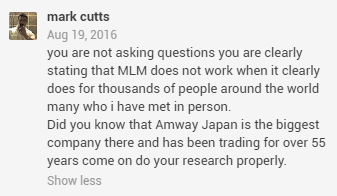
Here are a random sample of several "not-facts" thrown out for sake of argument by these MLM supporters, all the while chanting "Worre pwn'ed Ramsey!" in the Youtube comments of a Dave Ramsey show where Ramsey provided some realistic outlook on MLM.
It makes one wonder, do they just make up "facts" as they go along?
S1. "MLM works for thousands of people around the world"
S2. "Amway Japan is the biggest company there and has been trading for over 55 years."
A1. I never said anything about "MLM doesn't work", but that's ignore that for the moment, as he did. He put up a strawman, then cited a non-sensical fact in support. "Thousands of people around world" found MLM to be working...
DSA estimates that there are 20.2 million (per 2015 fact sheet, DSA.org) in the US alone, and probably 100 million around the world, in MLM. If only "thousands" found it works, that would suggest TENS OF MILLIONS found it did not work, doesn't it?
Factualness rating: D, true, but not placed in context. A system that works for a tiny minority cannot be considered a working system.
A2. Even a modicum of logic should tell you this is impossible. The biggest corporations in Japan, the haibatsus are hundreds of billions big. Toyota's revenue from 2013 was 224 BILLION dollars. This guy seriously thinks Amway in Japan can beat 224 billion? How old did he thinks Amway is any way? Amway Wiki states clearly that Amway Japan opened in 1979. That makes it 37 years old, certainly quite a bit off from 55. And its revenue, as per Amway was 1.1 billion USD (2006) again, AmwayWiki.
Factualness rating: F, completely false in every facet
Here are a random sample of several "not-facts" thrown out for sake of argument by these MLM supporters, all the while chanting "Worre pwn'ed Ramsey!" in the Youtube comments of a Dave Ramsey show where Ramsey provided some realistic outlook on MLM.
It makes one wonder, do they just make up "facts" as they go along?
S1. "MLM works for thousands of people around the world"
S2. "Amway Japan is the biggest company there and has been trading for over 55 years."
A1. I never said anything about "MLM doesn't work", but that's ignore that for the moment, as he did. He put up a strawman, then cited a non-sensical fact in support. "Thousands of people around world" found MLM to be working...
DSA estimates that there are 20.2 million (per 2015 fact sheet, DSA.org) in the US alone, and probably 100 million around the world, in MLM. If only "thousands" found it works, that would suggest TENS OF MILLIONS found it did not work, doesn't it?
Factualness rating: D, true, but not placed in context. A system that works for a tiny minority cannot be considered a working system.
A2. Even a modicum of logic should tell you this is impossible. The biggest corporations in Japan, the haibatsus are hundreds of billions big. Toyota's revenue from 2013 was 224 BILLION dollars. This guy seriously thinks Amway in Japan can beat 224 billion? How old did he thinks Amway is any way? Amway Wiki states clearly that Amway Japan opened in 1979. That makes it 37 years old, certainly quite a bit off from 55. And its revenue, as per Amway was 1.1 billion USD (2006) again, AmwayWiki.
Factualness rating: F, completely false in every facet
Friday, August 5, 2016
Cognitive Bias: Status Quo Bias
Status quo bias goes by many names, but to put it simply, "if it works why change anything" Any change form the current situation is judged to be unacceptable.
Scam victims often suffer from status quo bias, esp. after they learned the scheme they've latched onto or recruited into isn't on as firm legal and financial footing as they were lead to believe. Even when presented with all the evidence that they are in a scam, they will keep saying "I don't know if XXX is a scam. Time will tell." They don't want anything to change, even when more viable alternative such as attempt to withdraw from the scheme, report fraud to the police, and so on seem to be more reliable method of dealing with the fraud.
Status quo bias is often mixed up with other biases, such as loss aversion, sunk cost fallacy, longevity (appeal to age fallacy), endowment effect, regret avoidance, and more.
Behavioral Economists Kahneman and Tversky published a paper back in 1982 that found people feel greater regret for bad outcomes that result from new actions taken, than for bad consequences that are the consequences of inaction. In other words, if doing something is bad, and not doing anything is also bad, people tend to do nothing. One possible explanation is people can then blame circumstances (I didn't change anything, circumstances changed) rather than take responsibility for their own choices. This is a fallacy, of course, since choice to do nothing is still a choice.
Endowment effect is also known as "divestiture aversion" in behavioral economics. Basically, people ascribe more value to things merely because they own them. It's also related to "mere ownership effect" in social psychology. It can be described simply as "once you have it, you will want to keep it than give it up".
Sunk Cost fallacy is related, in that "once you started on a course of action, you justify your continual involvement by claiming you already spent effort and resources (sunk costs) and you cannot let it go to waste when it seems more prudent to cut the losses and change course."
As an example of endowment effect, people will often pay more to retain something they own, than to obtain something they do not own, even when there is no reason for attachment, and even when the object was obtained merely minutes ago.
Dan Ariely and Ziv Carmon did a test on hypothetical selling price (willingness to accept) NCAA Final Four tournament tickets. They found that the ratio of WTA (willingness to accept) vs WTP (willingness to pay) is 14 to 1. In other words, those who have the ticket want 14 times higher the price those that don't have the tickets are willing to pay.
Scam victims often suffer from status quo bias, esp. after they learned the scheme they've latched onto or recruited into isn't on as firm legal and financial footing as they were lead to believe. Even when presented with all the evidence that they are in a scam, they will keep saying "I don't know if XXX is a scam. Time will tell." They don't want anything to change, even when more viable alternative such as attempt to withdraw from the scheme, report fraud to the police, and so on seem to be more reliable method of dealing with the fraud.
Status quo bias is often mixed up with other biases, such as loss aversion, sunk cost fallacy, longevity (appeal to age fallacy), endowment effect, regret avoidance, and more.
Why Do We Have Status Quo Bias
Behavioral Economists Kahneman and Tversky published a paper back in 1982 that found people feel greater regret for bad outcomes that result from new actions taken, than for bad consequences that are the consequences of inaction. In other words, if doing something is bad, and not doing anything is also bad, people tend to do nothing. One possible explanation is people can then blame circumstances (I didn't change anything, circumstances changed) rather than take responsibility for their own choices. This is a fallacy, of course, since choice to do nothing is still a choice.
How Status Quo Bias interacts with other biases
Endowment effect is also known as "divestiture aversion" in behavioral economics. Basically, people ascribe more value to things merely because they own them. It's also related to "mere ownership effect" in social psychology. It can be described simply as "once you have it, you will want to keep it than give it up".
Sunk Cost fallacy is related, in that "once you started on a course of action, you justify your continual involvement by claiming you already spent effort and resources (sunk costs) and you cannot let it go to waste when it seems more prudent to cut the losses and change course."
As an example of endowment effect, people will often pay more to retain something they own, than to obtain something they do not own, even when there is no reason for attachment, and even when the object was obtained merely minutes ago.
Dan Ariely and Ziv Carmon did a test on hypothetical selling price (willingness to accept) NCAA Final Four tournament tickets. They found that the ratio of WTA (willingness to accept) vs WTP (willingness to pay) is 14 to 1. In other words, those who have the ticket want 14 times higher the price those that don't have the tickets are willing to pay.
Tuesday, July 19, 2016
How to spot shady opportunities V2.0: a 10 item checklist
World is full of Shady Opportunities that want you to put in money with promises of payback. Here are ten signs of shady schemes. Obviously a scheme probably would not have all ten, but the more signs you spot, the more likely it will be a scam.
- Clickbait-y Slogan
- Misinterpreted results
- Conflict of interest(s)
- Correlation vs. Causation
- Weasel words
- Bad Samples
- (Lack of) Control Group
- Unverifiable testimonial and Improper disclosure
- Cherrypicked and unreplicable results
- Paid or fake media coverage and reviews
Clickbait-y Slogan
EVERYBODY hates clickbaits... They are headlines written with intentional hyperbole and tease to get you to tease. Shady opportunities are the same. Does the scheme make incredulous claims such as "On our team everyone makes money"? Or they somehow "Pay One time $289 and get a minimum of $1040 back Guaranteed!" perhaps? Before you say "nobody is stupid enough to make this sort of stupid claims"... think again:
![]() |
| Screen cap of Google Search results, yes, someone promised and guaranteed that $289 will magically grow to $1040 and more. It's obviously clickbait. |
As Carl Sagan said before, "extraordinary claim requires extraordinary evidence". If they made such extraordinary claim, then they should supply the extraordinary evidence to support their claim. And since there are so many ILLEGAL ways of making money... Making money in itself is no proof.
It doesn't matter if the claims are repeated by the people you trust. They could have been duped and/or brainwashed. If they didn't ask for extraordinary evidence and is convinced of such, then you should not trust their judgement, esp. when they are in no position to evaluate such.
Misinterpreted Results
We are all affected by confirmation bias to one extent or another. If we hear some evidence, we are going to interpret them based on your experiences, while someone else may see the same data and interpret them very separately. Here's another example:
| Monty comic / Is it going to be McCain or Obama? (old joke on confirmation bias) |
The sales pitch is designed to say "just enough" so you think it applies to you, and NOT tell you that parts that "this may not apply to you"... so you can misinterpret the results to be relevant.
Your mindset affects how you interpret the results, and willful blindness, Dunning-Kruger effect, and self-serving bias will lead you down the wrong path.
Conflict(s) of interest
Most MLM companies in the "lotions and potions business" (nutritional supplements and cosmetics) employ scientists to carry out and publish research... But remember, those scientists may have conflict of interest, and if they did not disclose so, that is a huge ethical violation, as research can be misrepresented for personal or financial gain.
The worst example of which is (former doctor) Darryl M. See, who previously was a researcher at UC Irvine. He wrote a paper touting a Mannatech (MLM) product that he claimed has proven results in his study, and got it published in pretty famous American medical journal on nutrition. However, he never disclosed that 1) he had resigned from UC Irvine months before publication to pursue a career endorsing Mannatech (and was paid thousand per day for speaking gigs), 2) his wife had been a Mannatech rep for years, and 3) he made dozens of audio tapes sold at Mannatech conventions and seminars touting Mannatech products 4) His father was a personal friend of the journal's publisher.
When the news broke, UC Irvine had NO RECORD of any such study had occurred, but Mannatech's president already announced such to its legion of reps. In the end, Mannatech sued See, who jumped to a different company, before eventually forced to give up his medical license due to multiple medical ethics violations.
If someone suggests MLM as a way to solve your financial needs, you need to consider... Are they really doing it because they think it's the right thing for you to make some money... or is it because THEY, by recruiting you, will make some money off of you joining?
Stay skeptical of any and all claims, esp. when it is done with the ultimate aim to recruit you.
Correlation vs. Causation
When two things happen together, it does NOT mean one caused the other, despite how much you feel one *must* have caused the other.
| XKCD... Did cell phone cause cancer... or did cancer cause cell phones? |
| Is there relation between Autism and Organic Food? They correlate to the third decimal point!?!?! |
Yet many MLMers want you to believe that their nutritional supplement made them healthier, their magic rub took away their pain, their magic juice / tea / coffee took away their diabetes, and so on, because those effects "only" appeared when they started using those stuff.
For those of you who watch Stephen Colbert, this is related to the difference between the truth... and truthiness. Or as Colbert himself puts it:
Truthiness is 'What I say is right, and [nothing] anyone else says could possibly be true.' It's not only that I feel it to be true, but that I feel it to be true. There's not only an emotional quality, but there's a selfish quality.
If you BELIEVE it's causation, you'll never accept it's merely correlation. If you believe your nutritional supplements made you feel better, or that special widget increased your car's mileage by 15%, you'll never believe accept that the supplement's merely placebo effect, and the widget is relying on your lighter foot as you FEEL less need to speed and get better mileage. You believe truthiness (There is an effect and I caused it!) instead of the truth (It's just correlation and coincidence).
Correlation is NOT causation (until proven otherwise).
Sunday, June 12, 2016
Cognitive Bias: Choice Supportive Bias (aka Post-hoc Rationalization)
Previously we have often talked about cognitive dissoance, which is basically when a person is faced with two sets of "truths", and they conflict, therefore one set of which must be false.
For example, let's say the person has joined a suspect scheme, and is withdrawing money bi-weekly, but not yet achieved breakeven. Then he's exposed to a source that explained that the scheme is a scam with trustworthy sources.
So, how does one resolve this conflict between two sets of facts... a) the scheme works, I am getting paid and b) the scheme is a scam ?
One way the conflict can be resolved is through "choice supportive bias", also known as post-hoc rationalization. As the person is already in the scheme, the person is likely to choose to continue in the scheme and therefore decide that the trustworthy sources (that explain the scheme is a scam) are NOT acceptable.
Basically, the person wants the answer to be "scheme is fine" and thus chose that outcome, and came up with reasons to discount the trustworthy sources post-hoc (after the fact). Normal logic is check all the sources, then arrive at the conclusion. This is the reverse... The person know the conclusion s/he wants, then come up with the reasons later. It's motivated thinking.
As you can probably guess, motivated thinking means more often than not the person will reach the WRONG conclusion, since the conclusion was NOT deduced from logic, but emotion.
Let's look at some examples...
For example, let's say the person has joined a suspect scheme, and is withdrawing money bi-weekly, but not yet achieved breakeven. Then he's exposed to a source that explained that the scheme is a scam with trustworthy sources.
So, how does one resolve this conflict between two sets of facts... a) the scheme works, I am getting paid and b) the scheme is a scam ?
One way the conflict can be resolved is through "choice supportive bias", also known as post-hoc rationalization. As the person is already in the scheme, the person is likely to choose to continue in the scheme and therefore decide that the trustworthy sources (that explain the scheme is a scam) are NOT acceptable.
Basically, the person wants the answer to be "scheme is fine" and thus chose that outcome, and came up with reasons to discount the trustworthy sources post-hoc (after the fact). Normal logic is check all the sources, then arrive at the conclusion. This is the reverse... The person know the conclusion s/he wants, then come up with the reasons later. It's motivated thinking.
As you can probably guess, motivated thinking means more often than not the person will reach the WRONG conclusion, since the conclusion was NOT deduced from logic, but emotion.
Let's look at some examples...
Friday, June 10, 2016
Mythbusting: The Trump University is based on (some) bogus research
Trump University was in the news a lot, and it seems it may be the only thing that really got Trump riled up, as it's something he can't deny or denigrate... since it's his own. So instead, he denigrated everybody else... including the judge, which lead to furious denunciation by Republican leadership, who are put between the rock and the hard place of "supporting" their presumptive nominee WHILE wondering WTF happened that lead to this guy winning. The furor was so loud even Trump himself furiously backpedaled, claiming his comments were "misconstrued".
But we know EXACTLY what you mean, Mr. Trump.
In digging through some info about the Trump University, I came across its sales playbook dug up by Politico a while back. And it has some interesting information in it. Basically, they don't talk to the media, they don't let the lecturers over promise (any such incidents are reported to main office), and they will use psychological pressure to push you into buying their more expensive courses...
Including a bogus urban myth, such as "most persuasive words... from Yale University"
On page 99 of the document, you can find this:
The important part says:
But we know EXACTLY what you mean, Mr. Trump.
In digging through some info about the Trump University, I came across its sales playbook dug up by Politico a while back. And it has some interesting information in it. Basically, they don't talk to the media, they don't let the lecturers over promise (any such incidents are reported to main office), and they will use psychological pressure to push you into buying their more expensive courses...
Including a bogus urban myth, such as "most persuasive words... from Yale University"
On page 99 of the document, you can find this:
| Trump University Playbook, as posted by Politico.com, see URL on top |
The important part says:
The most persuasive words in the English language according to a study by the Psychology Department of Yale University are: You, New, Money, Easy, Discovery, Free, Results, Health, Save, Proven, Guarantee, and LoveExcept there was no such study. This is an urban legend.
Tuesday, May 31, 2016
Scam Psychology: "You have to try it to understand it" fallacy
One of the most popular fallacies trotted out by scammers and scammed sheeple is "you have to try it to understand it". It has a cousin known as "you're not in it (so shut up)" argument.
Basically, the claim that any criticism levelled at the scheme is premature because the critics have not tried the scheme. The implication is once the critic have tried the scheme s/he will change his/her mind. It basically takes this form
The argument is non-sensical, and here's a very appropriate reply quip for such idiocy:
(Thanks to justicealwayslate on Facebook)
There are plenty of other quips, like "oh, so cops have to be criminals first to arrest criminals, huh?" or "do I have to shoot myself to know it's a bad idea?" or "Do morticians have to die to be a mortician?" But you get the idea. It's ridiculous.
Basically, the claim that any criticism levelled at the scheme is premature because the critics have not tried the scheme. The implication is once the critic have tried the scheme s/he will change his/her mind. It basically takes this form
A: Acme XYZ is a scam because of ____, _____, and _____.
B: But you don't know Acme XYZ. How could you when you're not a member? Join us.The reply sounds very sensical, until you realize one thing: It never addressed your point: "Acme XYZ is a scam". It is completely irrelevant. It is a red herring. It neither disproves your premise, nor does it prove a counter premise.
The argument is non-sensical, and here's a very appropriate reply quip for such idiocy:
"So you have to eat shit to know not to eat it, huh?"
(Thanks to justicealwayslate on Facebook)
There are plenty of other quips, like "oh, so cops have to be criminals first to arrest criminals, huh?" or "do I have to shoot myself to know it's a bad idea?" or "Do morticians have to die to be a mortician?" But you get the idea. It's ridiculous.
Subscribe to:
Posts (Atom)