Tuesday, September 6, 2016

Cognitive Bias: Sunk Cost Fallacy

Answer this following question to yourself, truthfully please. Remember, it's for you and you alone. Only you would know the answer.

Q: Do you make rational decisions based on the best-estimate future value of objects, investments, and experience? 

Your answer to yourself is probably going to be: Yes, of course.

You are wrong. In reality, your decisions are based on your EMOTIONAL investment you already made and accumulated, and the more you invest, the less likely you can let it go. 

This is a cognitive bias known as "sunk cost fallacy".  In short, you are basing your decision on what has been invested, rather than what it's worth NOW (or in the future).

And it's very simple to make you feel you've invested time and effort... by making you do trivial tasks that amounts of zero importance. Zookeepers (and pet owners) know this principle well... it's called "contra-freeloading".

Contrafreeloading is a term coined in 1963 by animal psychologist Glen Jensen, who created an experiment where 200 albino rats were given a choice: unlimited food pellets in little bowl, or a mechanism where they have to learn to press a lever to release a food pellet. Logically, rats should simply gorge on the effortless food and never touch the lever. However, the opposite happened... rats actually prefer the food source where they had to press a lever, by a large margin. This was since repeated in gerbils, mice, birds, fish, monkeys, chimps... and more. (The only exception is the domestic cat). In short, animals prefer doing a little work (but not too much) for their food, rather than just take a handout.

A great example of contra-freeloading in a scam is ZeekRewards ponzi scheme (as accused by SEC and USSS), an $850 million scheme will soon go to trial. In ZeekRewards, one supposedly buy bids in the Zeekler penny auction, give away the bids to random strangers as promotion, and gets rewarded with certain amount of daily profit based on the bids purchased for the next 90 days. One also needs to post ads to random places on the Internet, and then post the URL on the ZeekRewards website as "verification" to be rewarded. In reality the vast majority of the bids were never used (i.e. the participants simply put money into the system) and expect daily "profit share" of up to 1.8% of the money they put in. The daily posting of ads were never tracked and verified, and indeed some people started a blog just to post ads... that nobody will ever read or see. It's rather obvious, in hindsight, that the "posting the ad" must be contrafreeloading... to make the participant feel they "worked" for and "earned" their share of "profit" amounting to as high as 1.8% DAILY, when the trivial task can literally be done in a few minutes, and be outsourced to some kids for pennies a day.

Yet when all these facts were pointed out to the ZeekRewards affiliates, their answers often are "you work for a competitor", "you work for the 1% to oppress us", "why don't you want us to succeed", and so on. After Zeek was shut down, several members even outright claimed "there were no victims until the government came along."

Curt Miller, on FB, soon after Zeek was closed by USSS and SEC, claiming that
"there were no victims (in ZeekRewards) until the government came along". 

They are so emotionally (and financially) invested into ZeekRewards, they can longer think rationally and see reason, even when there is NO REASON to continue to behave irrationally.

It is illogical to continue to support an alleged scam AFTER the owner made a plea deal with the government. However, hundreds of people donated money to a organization that promised to put the money toward "defending" ZeekRewards from the SEC. The owner of such organization was later jailed for defrauding the US government in an unrelated matter. The so-called defense ended up being an attorney who attended the receivership meetings, and filed several motions that was denied. He accomplished nothing useful except delay the process for the rest of the victims, and it was widely rumored (but never confirmed) that the rest of the money went to the organizer's private plane's upkeep.

They are the embodiment of sunk cost fallacy.


Friday, September 2, 2016

Scam Psychology: How Threshold of Collective Behavior Affects Victim's Mindset


Readers of this blog have remarked that they are very surprised at how a victim will refuse to acknowledge s/he is a victim, despite very clear evidence that are indisputable, repeatedly demonstrated, even by the leader of the scheme. The victim simply ignores any evidence that is "negative" and accepts any evidence that is "positive". It is... completely irrational.

Yet irrational behavior is so prevalent, even when the behavior is CLEARLY demonstrated to be irrational. The perfect example? Basketball legend Wilt Chamberlain.

Wilt Chamberlain's 100-point game
(Photo credit: 
Wikipedia)
Wilt Chamberlain, despite his legendary status, was a HORRIBLE free throw shooter. For his entire career... his free throw shooting percentage is... 51%. However, this guy once scored 100 points in an NBA game... BY HIMSELF!!!!!!  And in this game, he made 28/32 free throws... with UNDERHANDED throw! He made the first nine free throw shots! He tried doing this underhanded throw for a while and improved to 70+% accuracy rather than 50% of his normal overhand throw. So you'd think he'd keep doing it, right? WRONG! He went back to being a BAD shooter, because... Wilt Chamberlain does NOT want to throw underhanded. He "felt silly, like a sissy."

The choice to switch back to the 50% overhand free throw is an IRRATIONAL decision.  How can one of the greatest NBA players choose to play badly... just because... he felt bad even though the results speak for itself? Even today, the underhand throw is known as a "granny shot", and there are almost NO professional or semi-pro basketball players using it (only two in NBA, IIRC).

This sort of irrational behavior is very much in evidence when it comes to scam victim's mindset. Scam victims have been known to organize rallys "in support" of their ponzi scheme, interfere in government probes and sometimes, even sue the government in attempts to "clear the name" of the scheme they were involved in.

Sociologists believe this may have something to do with "threshold of collective/group behavior", where people will choose to follow a group, despite the group is NOT something they believe in. Like Wilt Chamberlain who chose to follow other players (in order not to feel sissy) instead of improve his scoring, scam victims will follow their group until the bitter end despite they know this can only turn out badly.


Thursday, September 1, 2016

Scam Tactic: "Don't knock it until you try it" slogan is very bad advice

One of the most common arguments for income schemes is "don't knock it until you try it", i.e. "it paid me so it works". This is actually a VERY flawed argument. Recently I came across the Skeptoid episode: don't try it until you knock it. While that's about general skepticism, it works very well for financial scam debunking as well, as it destroys all the variations of the bad argument.

Don't Knock It Until You Try It?  Nah. 


Personal experience is "sample size of one". It is noise. It subject to sunk cost fallacy, subjective validation, self-superiority bias, confirmation bias, and all the other cognitive biases. Mankind invented science and scientific process to counteract such biases.  Personal observation is subjective, and therefore biased information. Advocating one to "try it" simply proves nothing.

Yet MLMers love to fly this particular argument. They value personal experience over all others, the exactly opposite of scientific process trying to filter out bad data. It is basically fully faith-based.


I was skeptical until I tried it


A true skeptic would know NOT to try it due to all the reason discussed above. The proper way to evaluate something is through scientific and statistical process from a large sample set, not through a single subjective personal experience.

Falling for a dare / lure to "try it" just makes you gullible, not skeptical. Yet MLMers selling nutritional supplements or unproven "treatments" love to fly this particular argument.  (also see "What's the harm" below)


I know it works, because it worked for me


So somehow, you're God, and what you experienced is the universal truth for everybody, eh? It's just your subjective experience, based on your circumstances at the time, and based on all your PRIOR memory and experiences. If any one else had different life history, experienced the same thing at a different time, under different circumstances, or any combination of such, the experience will be different.

What you experienced is only good for yourself. It is not a data point. It is anecdote.

Tuesday, August 23, 2016

Where do these MLMers get their "facts"? Certainly not from this reality.

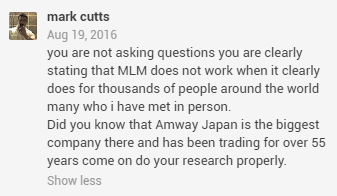
In attempting to engage with some MLMers regarding their unbridled enthusiasm, I've since found out they seem to be armed with a lot of... nonsense from somewhere. They surely don't seem to have just... invented it. But where did they get such nonsense that they perceive as "facts"?

Here are a random sample of  several "not-facts" thrown out for sake of argument by these MLM supporters, all the while chanting "Worre pwn'ed Ramsey!" in the Youtube comments of a Dave Ramsey show where Ramsey provided some realistic outlook on MLM.

It makes one wonder, do they just make up "facts" as they go along?


S1. "MLM works for thousands of people around the world"

S2. "Amway Japan is the biggest company there and has been trading for over 55 years."


A1. I never said anything about "MLM doesn't work", but that's ignore that for the moment, as he did. He put up a strawman, then cited a non-sensical fact in support. "Thousands of people around world" found MLM to be working...

DSA estimates that there are 20.2 million (per 2015 fact sheet, DSA.org) in the US alone, and probably 100 million around the world, in MLM. If only "thousands" found it works, that would suggest TENS OF MILLIONS found it did not work, doesn't it?

Factualness rating: D, true, but not placed in context. A system that works for a tiny minority cannot be considered a working system.

A2. Even a modicum of logic should tell you this is impossible. The biggest corporations in Japan, the haibatsus are hundreds of billions big.  Toyota's revenue from 2013 was 224 BILLION dollars.  This guy seriously thinks Amway in Japan can beat 224 billion? How old did he thinks Amway is any way? Amway Wiki states clearly that Amway Japan opened in 1979. That makes it 37 years old, certainly quite a bit off from 55. And its revenue, as per Amway was 1.1 billion USD (2006) again, AmwayWiki.

Factualness rating: F, completely false in every facet


Thursday, August 18, 2016

Eric Worre is wrong about Dave Ramsey: or, why MLM advocates only knows truthiness, not truth

If you are in the US, you probably heard of Dave Ramsey, who had been giving financial advice for decades as a radio call-in show (i.e. he goes live on air and lets normal people call him and he gives answers immediately) since 1992. He does not fully endorse multilevel marketing, but instead, advocates caution and realistic outlook, something that is inherently anti-faith, but based on evidence and reality. 

On August 10th, 2016, at about the 7:48 point, a "Sarah from Cincinnati Ohio" called in and asked about joining "It Works!" MLM.  Ramsey urged caution and be absolutely aware what she wants to do going in. His message was "... You will be in the recruiting business. There is nothing really inherently bad or evil about it, Your real job is training salespeople, in a high turnover environment, because most of them don't make it... I have friends that makes 7 figures in that business... But for every one of those, I know a thousand (chuckles) that didn't last 90 days, with six boxes of makeup in the garage they are still paying off on credit card... Is this really your calling if you had lost everything and starting from scratch? ... You ought to really thinking about what you're getting into. But if you want to give it a run, I will support you on it... " 

The MLM sphere went nuts as they reacted with venom. So-called MLM 'leaders' started posting videos 'Dave Ramsey is Wrong'. Here's a typical reaction from Eric Worre of networkmarketingpro.com:
Dave (Ramsey) went on to pour cold water all over the hopes and dreams of this young woman, and pigeon holed the Network Marketing profession into his very limited understanding of what it is all about.
So what exactly is Eric Worre mad about? He claims that Ramsey made multiple mistakes. 
  • Risk is minimal in MLM, w/ the buyback policies in place
  • It's not recruiting, it''s expanding your network
  • Failure? So what? 90% of traditional businesses fail
  • Bothering friends? They''re doing it wrong
Mr. Worre's final message is: basically "why don''t you just be honest and admit you hate network marketing? Innuendo doesn't suit you". 

Go look in a mirror, Mr. Worre. Innuendo does not suit you either. 

Let's examine the factors at play... who''s really wrong or right? But with a skeptical attitude and fact-checking. 

Just how risky is MLM?

Eric Worre claims that Dave Ramsey exaggerated the risk involved in MLM, and most people don''t have "6 boxes of makeup sitting in the garage getting paid off on credit card".  He claims that with the 90% buyback policy in place in most major MLMs (esp. DSA members), financial exposure is minimal.

The problem with Mr. Worre's statement is there are NO stats available from the MLMs that such policies have been utilized. Yes, DSA members do have at least a 90% buyback policy for at least six months, i.e. if you want to return all the stuff you haven''t sold within 6 months, you get 90% back. Some even go as far as a year. However, there are various caveats not discussed. 

Is there any stats available on how often such policies had been invoked? How many hoops do people have to jump through to get such returns processed? 

Nope. Nada. Zero. Zilch. Nothing. 

In fact, it's been documented in Mary Kay that any attempts to quit an return inventory would trigger an "intervention" from your upline and other people in your group (because she would be notified as any returns means her commission from your purchases will be clawed back) who will want to meet with you then shame and guilt you into staying in past the refund deadline, or to delay you in order to ensure you will get as minimal refund as possible. 
Mary Kay sales directors and recruiters are notorious for using misinformation or unethical tactics to stop consultants from returning inventory. This includes lying about the program or otherwise delaying the consultant’s return so that less product can be returned under the “last 12 months” rule. -- PinkTruth.com
It's hard to imagine the same does not happen in other MLMs as well. 

There are other tricks that can be done as well, like refresh products at less than 12 month cycles. That way when you try to return product it had already been phased out and thus cannot be returned. 

Sure there's a policy on the books, but a policy that's never used / enforced is no policy at all. 

Mr. Worre's hypothetical "white elephant" MLM only exists in his imagination. 

Friday, August 5, 2016

Cognitive Bias: Status Quo Bias

Status quo bias goes by many names, but to put it simply, "if it works why change anything"   Any change form the current situation is judged to be unacceptable.

Scam victims often suffer from status quo bias, esp. after they learned the scheme they've latched onto or recruited into isn't on as firm legal and financial footing as they were lead to believe. Even when presented with all the evidence that they are in a scam, they will keep saying "I don't know if XXX is a scam. Time will tell." They don't want anything to change, even when more viable alternative such as attempt to withdraw from the scheme, report fraud to the police, and so on seem to be more reliable method of dealing with the fraud.

Status quo bias is often mixed up with other biases, such as loss aversion, sunk cost fallacy, longevity (appeal to age fallacy), endowment effect, regret avoidance, and more.


Why Do We Have Status Quo Bias


Behavioral Economists Kahneman and Tversky published a paper back in 1982 that found people feel greater regret for bad outcomes that result from new actions taken, than for bad consequences that are the consequences of inaction. In other words, if doing something is bad, and not doing anything is also bad, people tend to do nothing. One possible explanation is people can then blame circumstances (I didn't change anything, circumstances changed) rather than take responsibility for their own choices. This is a fallacy, of course, since choice to do nothing is still a choice.


How Status Quo Bias interacts with other biases


Endowment effect is also known as "divestiture aversion" in behavioral economics. Basically, people ascribe more value to things merely because they own them. It's also related to "mere ownership effect" in social psychology.  It can be described simply as "once you have it, you will want to keep it than give it up".

Sunk Cost fallacy is related, in that "once you started on a course of action, you justify your continual involvement by claiming you already spent effort and resources (sunk costs) and you cannot let it go to waste when it seems more prudent to cut the losses and change course."

As an example of endowment effect, people will often pay more to retain something they own, than to obtain something they do not own, even when there is no reason for attachment, and even when the object was obtained merely minutes ago.

Dan Ariely and Ziv Carmon did a test on hypothetical selling price (willingness to accept) NCAA Final Four tournament tickets. They found that the ratio of WTA (willingness to accept) vs WTP (willingness to pay) is 14 to 1. In other words, those who have the ticket want 14 times higher the price those that don't have the tickets are willing to pay.


Friday, July 29, 2016

SEC Halts Traffic Monsoon Ponzi Scheme, Reasserts that "Autosurf Ponzis" are illegal

The internet buzz on July 28th 2016 was the press release that SEC has halted the $207 Million Ponzi scheme called Traffic Monsoon.

Traffic Monsoon was operated by Charles Scoville, as a combination "internet traffic exchange and pay-per-click program" that solicited money from all over the world. It accepted money from at least 162000 investors primarily in US, India, and Russia by claiming to be a "highly successful advertising company", when in reality, more than 99% of the revenue was paid into the system by new investors, making it a classic Ponzi scheme.  Traffic Monsoon LLC is a Utah company. Scoville is believed to be in Dubai. SEC's motion to have an temporary freeze and receiver to take over the company has been granted.

Traffic Monsoon's primary product (which accounted for 99.6% of all revenue) is the "Adpack". At $50 each, purchaser is supposed to get 20 clicks on the banner (either they provide, or they can use one provided by Traffic Monsoon) and 1000 visitors from the traffic exchange, as well as "share in Traffic Monsoon's profit". In reality, TM was never able to fulfill the visitor promise. By its own counter, it can only provide about 1/10th of the visitors. In reality, TM operated as a $50 in, $55 out HYIP.

Those that track scams, such as the MLMSkeptic, would notice that this is structurally IDENTICAL to 12DailyPro (2005-2006) or Ad Surf Daily (2006-2008), both were also prosecuted as autosurf ponzi schemes.

What's more interesting is Charles Scoville himself has been observed operating several predecessors to Traffic Monsoon. There's TVIBUX, and there's AdHitsProfits, both are slight variations on the same ideas. Neither, however, made it big to hundreds of millions of dollars.

But first, let's explain what an autosurf is, and what an investment autosurf.

What is an autosurf? 


Autosurf is a type of Internet website traffic exchagne that automatically rotate advertised websites in the web browser.  Imagine leaving a browser window open to constantly display banners from all the other websites, which changes periodically. Each "view" earns you a "credit" which allows your site's banner some display time in other people's browser window.

Autosurf can operate as a "ponzi scheme" even if no money changes hands, if overall credits earned is in excess of total pageviews delivered, thus ensuring that there will always be credits left over.

Autosurf that involve money are known as Investment autosurfs.